


“I’ve already asked you three times to clean your room!” Sound familiar? Getting kids to help around the house often feels like an uphill battle. But age-appropriate chores do more than just lighten your load—they build essential life skills. Children who participate in household responsibilities develop competence, confidence, and a sense of contribution.
Why Chores Matter More Than You Think
Dr. Marty Rossmann, emeritus professor at University of Minnesota, found that children who began chores at ages 3-4 were more likely to have good relationships, academic success, and early career success. Her research shows that involvement in household tasks as young children was the single best predictor of young adults’ success.
“Chores are about more than clean dishes,” explains Dr. Deborah Gilboa, family physician and parenting expert. “They’re about raising humans who can care for themselves and contribute to their communities.” 


Setting the Stage for Success
Before diving into specific chores, establish these foundational elements:
- Use the right language: “Contributions” or “responsibilities” often feel more positive than “chores”
- Start early: Even toddlers want to help—capture that natural enthusiasm!
- Work alongside: Children learn by watching you first
- Focus on process, not perfection: An imperfectly made bed still builds skills
- Be consistent: Irregular expectations create confusion
Dr. Laura Markham, clinical psychologist and founder of Aha! Parenting, notes, “When we invite children to contribute rather than ordering them to do chores, we nurture their intrinsic motivation to be helpful.”


Toddlers (Ages 2-3): Little Helpers with Big Pride
Those tiny hands are eager to help! Embrace their enthusiasm with these developmentally appropriate tasks:
- Put toys in a bin or basket
- Place dirty clothes in hamper
- Wipe up small spills with a cloth
- Help feed pets (with supervision)
- Place napkins on the table
Child development expert Dr. Tovah Klein, author of “How Toddlers Thrive,” explains, “Toddlers crave meaningful participation. When we make space for their help—even if it takes longer—we’re building their sense of capability.”
Preschoolers (Ages 4-5): Growing Independence
Preschoolers develop more coordination and can follow simple multi-step instructions. Try these age-appropriate chores:
- Make their bed (simple pull-up of covers)
- Help unload groceries
- Clear their own plate after meals
- Water plants
- Help sort laundry by color
- Assist with simple food prep
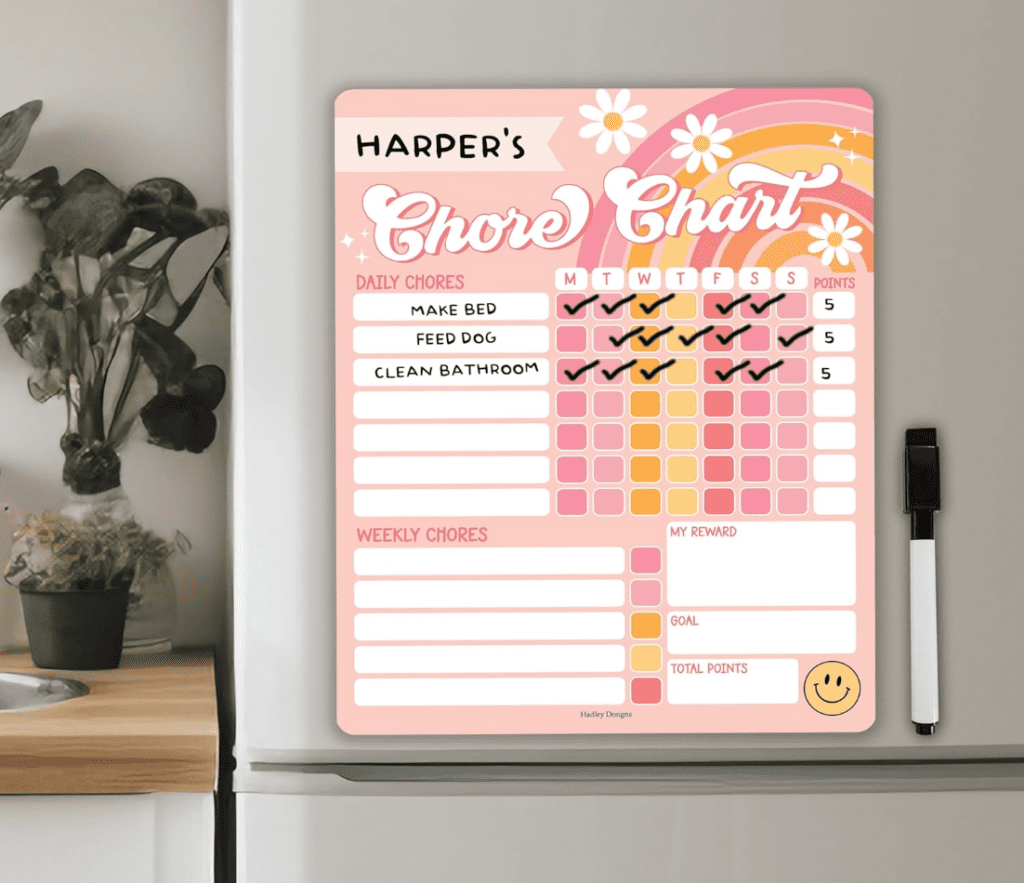
Educational psychologist Dr. Michele Borba advises, “Create visual reminders for young children. Simple picture charts help them remember their responsibilities without constant reminders.”
Early Elementary (Ages 6-8): Competence Builders
School-age children can handle more complex tasks with less supervision:
- Make their bed completely
- Load dishwasher
- Take out smaller trash bins
- Fold and put away simple laundry
- Vacuum accessible areas
- Help prepare simple meals
“Children this age thrive on clearly defined expectations,” explains Dr. Eileen Kennedy-Moore, child psychologist and author. “Establishing regular chore routines helps them internalize responsibility.”


Tweens (Ages 9-12): Responsibility Expansion
Tweens can handle more complex household contributions:
- Do their own laundry from start to finish
- Clean the bathroom thoroughly
- Prepare basic meals
- Wash the family car
- Help with grocery shopping
- Mow the lawn (with supervision)
Dr. Madeline Levine, psychologist and author of “Ready or Not,” notes, “Tweens who master household skills develop a strong sense of self-efficacy that transfers to other areas of their lives.”
Teens (Ages 13-18): Life Skills for Launch
Teenagers should be developing adult-level household competencies:
- Meal planning and preparation
- Grocery shopping with a list and budget
- Deep cleaning of household areas
- Minor household repairs
- Managing their own schedule and appointments
- Car maintenance basics
Julie Lythcott-Haims, former Stanford dean and author of “How to Raise an Adult,” emphasizes, “By age 18, young people should be capable of managing the basic tasks of adult life. These skills don’t magically appear—they develop through years of practice.”


The Great Motivation Question: To Pay or Not to Pay?
Should children receive allowance for chores? Experts are divided.
Dr. Denise Pope, co-founder of Challenge Success, suggests, “Consider separating basic household contributions from opportunities to earn money. Basic chores build family citizenship, while additional tasks can be connected to earning.”
Many families find success with this hybrid approach:
- Basic responsibilities: Expected without payment as part of family membership
- Extra opportunities: Additional tasks available for earning money
- Financial literacy: Regardless of your system, use it to teach money management


Overcoming Common Challenges
Even with the best age-appropriate chore ideas, you’ll face resistance. Here’s how to handle common hurdles:
“But I don’t want to!”
- Acknowledge feelings while maintaining expectations
- Offer limited choices within the task
- Use natural consequences (no clean clothes means nothing to wear)
“I’m too busy!”
- Help them identify actual time requirements
- Teach task-scheduling skills
- Establish non-negotiable time blocks
Parenting expert Amy McCready advises, “When children claim they’re too busy for chores, it’s often a great opportunity to discuss priorities and time management—skills they’ll need throughout life.”
Starting Today: Your Family Chore Plan
Begin your household responsibility system with these steps:
- Family meeting: Discuss the importance of everyone contributing
- Developmentally appropriate tasks: Select a few age-appropriate chores for each child
- Clear expectations: Define what completion looks like
- Tracking system: Choose a method that works for your family
Remember that establishing new habits takes time. Clinical psychologist Dr. Wendy Mogel advises, “Expect it to take 4-6 weeks of consistent expectations before new responsibilities become habits.”
By implementing these age-appropriate chore ideas, you’re not just creating a cleaner home. You’re raising capable, confident children who understand their power to contribute meaningfully to their world. That’s a legacy worth the effort!